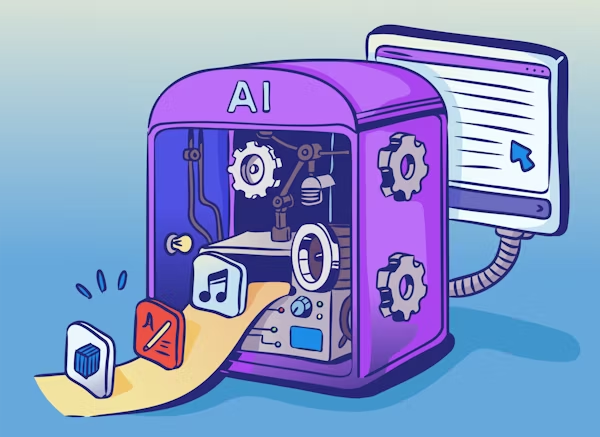
The Productivity Paradox: Why More Tools are Actually Killing Your Focus

Most professionals today are overwhelmed by a “productivity stack” that does anything—and anything—except actually produce results. We’ve been sold a lie: that you have to automate every single thing to be a “company of the future,” and that every micro-problem requires a new AI subscription to fix it. The result? You end up managing the tools that were supposed to work for you, losing the very time they were meant to save in a never-ending cycle of syncing and updating.
The Productivity Paradox
Tool overload has brought us to a breaking point. We have to ask ourselves: is it worth it? Many of these tools cost more time and money than they save, stealing the resources we should be spending on high-value tasks. In 2026, this is the leading cause of “Digital Fatigue.” Beyond just feeling tired, scientific research published by The Royal Society suggests that our cognitive control is being fundamentally reshaped by these constant digital interruptions, making it harder to sustain the deep thinking required for high-level business decisions.
The Illusion of Efficiency: When Integration Becomes Friction
Too many companies and projects are currently trapped in a “Frankenstein Stack.” We use Zapier to glue App A to App B, but the moment an API breaks or a schema changes, the entire workflow grinds to a halt.
The reality is that integrations carry a hidden maintenance tax. Every time you jump from a deep-work session to a project management board just to “log” what you just did, you lose the mental momentum required to solve complex problems. We have prioritized “tracking the work” over actually “doing the work.” It looks great on a dashboard, but the bottom line doesn’t budge.
A Personal Perspective: I’ve seen a project spend $15,000 on a custom Salesforce implementation. Six months later, the sales team was using a private WhatsApp group to close deals while the CRM sat empty. The software didn’t fail—the complexity did. If a tool requires more effort to maintain than the benefit it provides, it’s a burden, not an asset.
The High Cost of Context Switching
Your brain isn’t a browser; you can’t run 50 tabs without a massive performance hit. Every time you switch windows, your brain has to “reload” the context of the new environment.
- The 23-Minute Rule: Research from Gloria Mark (UC Irvine) shows it takes an average of 23 minutes to return to deep focus after an interruption. If you check Slack every 10 minutes, you are effectively operating in a state of permanent cognitive impairment.
- The ROI Hit: The American Psychological Association (APA) notes that mental blocks created by shifting tasks can cost up to 40% of your productive time. This is backed by comprehensive data analysis from RescueTime, which reveals that the average knowledge worker can’t go more than 6 minutes without checking email or Slack, creating a state of constant, low-level distraction.
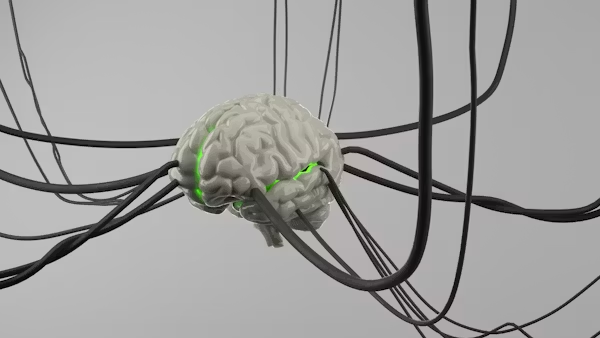
The “Maintenance Tax”: The Shadow Work of 2026
A critical error in modern workflows is ignoring the work behind the tool. This is the invisible labor: organizing tags, updating statuses, and migrating data.
If you spend 30 minutes a day “polishing” your project management tool, you are paying a Maintenance Tax. If a platform requires manual data entry across three different boards just to “stay organized,” you aren’t being productive. You’re just doing digital housekeeping, wasting valuable time that should be spent elsewhere.
Process vs. Automation: Why Software Can’t Fix Chaos
Automating a broken process only ensures that your mistakes happen faster. It’s that simple.
Most “Productivity Overload” comes from a lack of clear human processes. Your team needs real owners for specific tasks, using tools that provide genuine value under human supervision. Software is a multiplier; if you multiply a “zero process,” you’ll still get zero results. Stop looking for a digital solution to a human problem.
The L.E.S.S. Framework: Auditing Your Path to Focus
To make your workflow efficient, you don’t need a new app. You need a strategy for cleaning and restructuring.
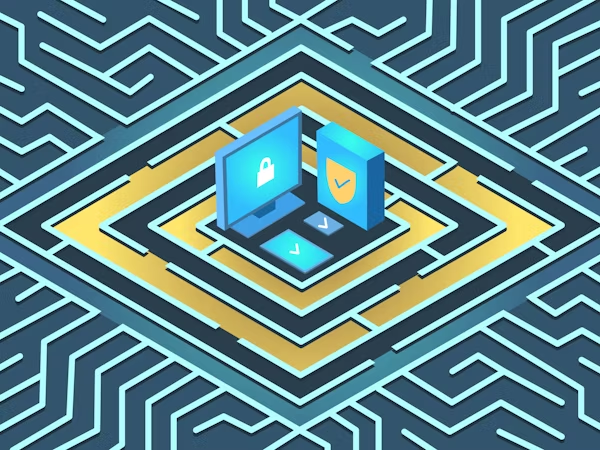
- Lean Inventory: List every app you pay for. As a rule of thumb, if you haven’t opened it in 10 days, consider deleting it. It’s likely just getting in the way. We often force ourselves to use tools just because we’re paying for them, without stopping to ask if we actually need the subscription.
- Efficient Consolidation: A unified platform that is “good enough” is always better than three disconnected apps that are “best-in-class.” The mental clarity of a coordinated system outweighs a list of tools that are great at one thing but work in silos.
- Scalable Simplicity: If a tool takes more than 30 minutes to explain to a new hire, it’s too complex. If your workflow requires a 50-page manual just to manage the software, you’ve built a labyrinth, not a business.
SaaS Sprawl: The Silent Budget Killer
Beyond the mental drain, there is SaaS Sprawl. Most companies pay for “Pro” features they never use. Monitoring the ROI of your tools isn’t just a technical move—it’s a smart financial one. Software is supposed to buy you time; if it’s only draining your bank account, it’s failing its only job.
FAQ: Solving Tool Overload
How many tools are too many? If you have to open more than three tabs to finish one task, your stack is fragmented. For most solo pros or small teams, a core of 3 to 5 tools (Email, Calendar, One Workspace, One Comms) is the “Goldilocks Zone.” Anything more is digital clutter.
Is “All-in-One” software always better? In 2026, generally yes. The mental clarity of a single interface beats the friction of moving data between “best-in-class” isolated apps.
How do I reduce without losing data? Try a “Read-Only” week. Don’t add data to any non-essential tool. You’ll quickly see which apps are vital organs and which are just noise. Export your data, cancel the sub, and see if you actually miss it.
Conclusion: Focus is Your Only Real Asset
The most successful people in tech don’t have the most complex setups; they have the most efficient ones. These projects understand that we tend to over-optimize things, and that over-optimization is a problem, not a solution. Behind every tool and automation, there must be a human. Stop looking for a digital solution to a human problem.
Related Strategic Intelligence
- The Rise of AI Super-Apps: Is the Standalone SaaS Dead?
- Workflow Automation for SMBs: From Chaos to ROI
- Deep Work Setups: The Tech Stack of High-Performers