AI Implementation Strategy for Companies: A Complete Executive Roadmap

Updated for 2026: Reflecting current enterprise AI adoption trends, governance standards, and large-scale implementation practices.
Artificial intelligence is no longer experimental — it is a strategic imperative for enterprises seeking growth, efficiency, and competitive advantage.
Despite large investments, many AI initiatives fail to deliver. Without a clear AI Implementation Strategy for Companies, the root cause is rarely technical; it is usually organizational misalignment, unclear objectives, or insufficient governance.
This guide provides a comprehensive, executive-level roadmap to implement AI successfully, focusing on strategy, adoption, governance, KPIs, and measurable business impact, while avoiding common pitfalls.
What Is an AI Implementation Strategy for Companies?
An AI Implementation Strategy for Companies is a structured, organization-wide plan that defines how AI is adopted, governed, deployed, and scaled to achieve business objectives.
It aligns:
- Business priorities and KPIs
- Organizational capabilities and digital maturity
- Governance, compliance, and ethical standards
- Cultural readiness and employee engagement
- Measurable outcomes and ROI
Why it matters: Without a clear strategy, companies risk fragmented pilots, wasted resources, and failed scaling. A robust strategy ensures every AI initiative contributes to tangible business value and avoids duplication or internal conflict.
Executive considerations:
- How does this AI initiative advance strategic goals?
- Who owns data, models, and outcomes?
- What governance ensures compliance and ethical use?
- How do we scale successful pilots responsibly?
Frameworks and Methodologies:
- Gartner AI Maturity Model: Assesses readiness and scaling potential.
- Forrester AI Lifecycle: Provides structured phases from pilot to enterprise deployment.
- AI Center of Excellence (CoE): Serves as central hub for governance, skill development, and best practices.
What it is not:
- A list of AI tools or vendors
- A technical deployment plan
- A marketing or experimental project
At its core, an AI implementation strategy is a business transformation framework, linking AI adoption to measurable business outcomes and clearly defining how companies use AI to scale and grow.
Quick Overview
| Topic | AI Implementation Strategy for Companies |
|---|---|
| Last Updated | February 2026 |
| Difficulty Level | Advanced (Executive / B2B) |
| Reading Time | ~15 minutes |
| Target Audience | Enterprise leaders, CIOs, Heads of Digital |
| Primary Focus | Strategy, governance, adoption roadmap |
| Benchmark | 37% of enterprises successfully scale AI beyond pilots (Gartner 2025) |
Why Many Companies Fail When Implementing AI
AI initiatives often fail due to organizational and strategic issues, not technology gaps. In many cases, the absence of a clearly defined AI Implementation Strategy for Companies prevents alignment between business objectives and execution.
Common failure patterns:
- Technology before strategy – Pilots without clear objectives generate data but no ROI.
- Unrealistic expectations – Executives expecting instant results risk disillusionment.
- Cultural resistance – Employees may fear job loss or lack skills, limiting adoption.
- Lack of governance – Undefined ownership and compliance gaps slow progress.
Risk Mitigation
| Risk | Mitigation | Why It Matters |
|---|---|---|
| Siloed initiatives | Centralize governance in an AI CoE | Prevents duplication and inconsistent results |
| Overpromised ROI | Start with small, measurable pilots aligned to KPIs | Builds confidence and sets realistic expectations |
| Employee resistance | Structured change management, communication, reskilling | Ensures adoption and engagement |
| Compliance failures | Define ethical AI policies, regular audits | Reduces legal, reputational, and operational risks |
| Poor data quality | Data audits, enrichment, integration | Critical for accurate AI predictions |
Mini-Cases of Success:
- Company A (Supply Chain, Fortune 500): Predictive analytics reduced operational costs by 15% in 6 months.
- Company B (Retail Enterprise): AI-driven customer insights increased revenue per client by 12%.
- Company C (Global Services Co.): Created a CoE, standardizing AI adoption across five business units.
These examples show that success stems from strategy, governance, and execution, not merely technology.
Assessing Organizational Readiness for AI Adoption
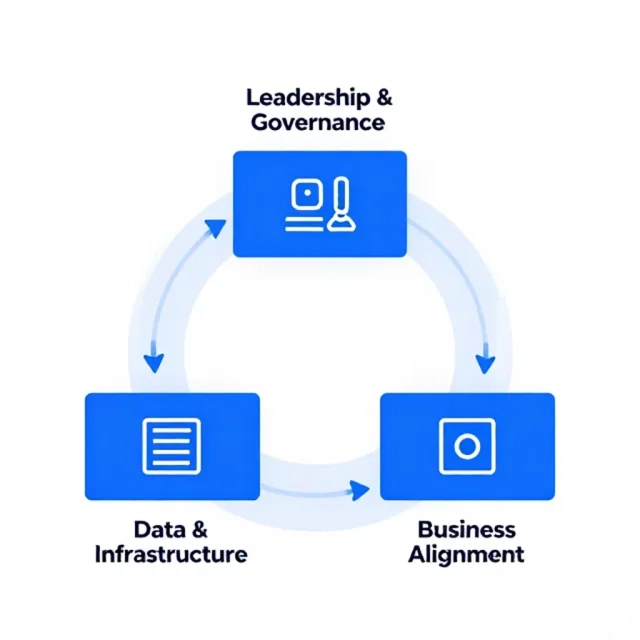
Before deploying AI, enterprises must evaluate readiness across people, processes, and technology, following structured models for enterprise AI adoption that assess alignment, governance, and cultural maturity.
Digital and Data Maturity
AI depends on high-quality, well-governed data and modern infrastructure.
- Data availability: Clean, accessible, integrated datasets.
- Analytics maturity: Existing predictive and prescriptive models.
- Infrastructure readiness: Cloud platforms, security, and scalability.
Red flags: Fragmented databases, inconsistent reporting, missing governance indicate preparation is needed before scaling AI.
Leadership and Governance
Alignment at the executive level ensures accountability.
- CoE roles: Strategy, project prioritization, metrics tracking, and compliance oversight.
- KPIs: Adoption rates, ROI, model accuracy, ethical compliance.
- Decision rights: Clear assignment of ownership for AI projects across business units.
Skills and Cultural Readiness
- Internal capabilities: AI literacy, analytics skills, project management.
- Culture: Employees must see AI as augmentation, not replacement.
Tip: Use a readiness scorecard evaluating each unit on data quality, skills, governance, and alignment. Focus pilots on the highest-scoring areas first.
Defining Where AI Creates Real Business Value
Not every process benefits equally from AI. Focus on high-impact areas:
- Operational efficiency (cost reduction, process automation through AI workflow automation)
- Decision-making speed and quality (analytics, forecasting)
- Customer experience and personalization
- Risk management and compliance
Prioritization Framework
| Use Case | Impact | Complexity | Priority | Rationale |
|---|---|---|---|---|
| Forecasting | High | Medium | High | Direct revenue and supply chain impact |
| Customer Support Automation | Medium | Low | Medium | Reduces costs, improves CX |
| Predictive Maintenance | High | High | Medium | Requires strong data integration |
| Marketing Insights | Medium | Medium | Low | Strategic benefit, lower operational urgency |
Framework Application: Multiply impact × feasibility × ROI to prioritize initiatives objectively. This ensures executives invest where value is greatest.
Governance, Leadership, and Change Management
Executive Sponsorship
Visible sponsorship sustains accountability and secures resources.
Governance Framework
- Roles and decision rights
- Ethical AI policies and compliance
- KPI tracking and reporting cadence
Change Management
- Internal communication plan emphasizing AI augmentation
- Employee training and reskilling programs
- Feedback loops for adoption and process improvement
Example: A global services company increased adoption by 40% after structured CoE training, leadership briefings, and cross-unit workshops.
Many enterprises align their governance structures with the AI Risk Management Framework to ensure responsible, secure, and compliant AI deployment.
Phased AI Implementation Roadmap
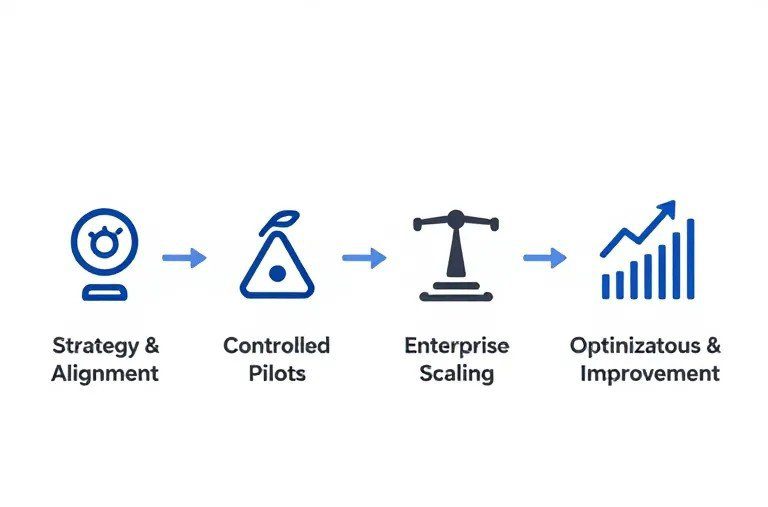
A well-defined AI Implementation Strategy for Companies translates strategic intent into execution through a phased, enterprise-wide roadmap.
A successful enterprise AI implementation follows a structured progression. Each phase builds organizational maturity, reduces risk, and prepares the company for scalable impact.
Phase 1: Strategy & Alignment
This phase defines why AI matters for the organization.
Executives must align AI initiatives with strategic business priorities, not isolated innovation efforts. This includes defining measurable KPIs, clarifying ownership, and establishing governance structures such as a Center of Excellence (CoE).
Common mistake: launching pilots before defining enterprise-wide success criteria.
A company is ready to move to Phase 2 when objectives, ownership, and evaluation metrics are clearly defined.
Phase 2: Controlled Pilots
Pilots validate feasibility and business impact in a controlled environment.
The goal is not experimentation for its own sake, but measurable ROI and operational learning. Each pilot should include defined adoption metrics, performance benchmarks, and executive reporting cadence.
Key question: Does this use case produce repeatable, scalable value?
Transition to Phase 3 only when ROI, adoption, and governance standards are validated.
Phase 3: Enterprise Scaling
Scaling requires more than replication.
Organizations must integrate AI into workflows, redefine processes, train teams, and strengthen infrastructure. Governance becomes more critical at this stage to avoid model drift, compliance risks, and fragmentation across departments.
Scaling success indicator: AI becomes embedded in decision-making routines, not just isolated tools.
Phase 4: Optimization & Continuous Improvement
At maturity, AI becomes an operating capability.
Companies monitor performance, retrain models, refine governance policies, and continuously measure long-term impact. The focus shifts from deployment to sustained competitive advantage.
Organizations that institutionalize this phase treat AI as a strategic capability, not a project.
KPIs per Phase
| Phase | KPI Examples |
|---|---|
| Strategy & Alignment | Executive alignment %, prioritized use cases |
| Pilots | ROI per pilot, adoption rate, model accuracy |
| Scaling | % departments adopting AI, efficiency gains |
| Optimization | Long-term ROI, compliance adherence, employee satisfaction |
Executive Checklist: AI Readiness
- Executive sponsorship secured – ensures accountability
- Business objectives and KPIs defined – aligns AI with strategy
- Data quality and infrastructure assessed – prevents scaling issues
- Governance model established – manages risks and compliance
- Pilot programs launched – validates feasibility
- KPIs tracked and measured – ensures ROI
- Continuous improvement plan defined – sustains AI maturity
Explore Best AI SaaS Tools for Businesses to align technology decisions with this roadmap.
Measuring Impact and ROI from AI Initiatives
Measuring AI impact requires both financial and operational metrics.
Short-term ROI often includes cost reduction, process automation savings, or revenue uplift from targeted use cases. However, enterprise AI maturity depends on broader performance indicators such as decision accuracy, cycle-time reduction, risk mitigation, and customer experience improvements, especially when AI analytics improves business decision making at scale.
According to McKinsey’s research on the state of AI and how organizations are capturing value, companies that scale successfully focus on measurable business outcomes rather than isolated technical performance
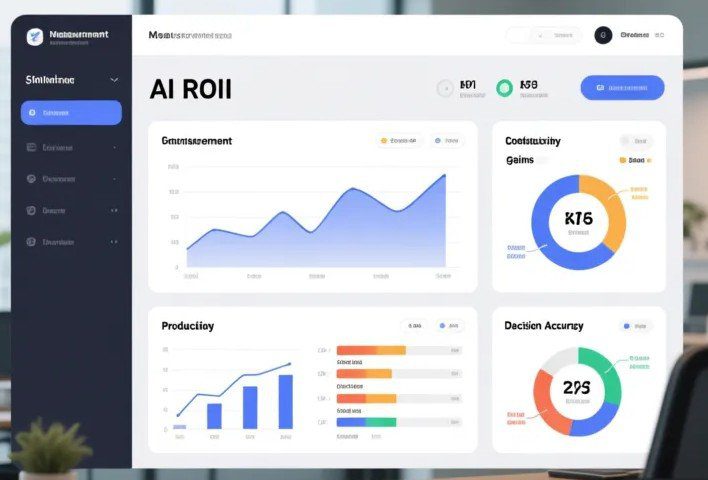
Executives should differentiate between:
- Direct financial ROI (cost savings, revenue growth)
- Operational efficiency gains (productivity, speed, quality)
- Strategic value creation (improved forecasting, competitive positioning)
A common mistake is focusing exclusively on early cost savings while ignoring long-term transformation impact.
Successful organizations track ROI per use case and per implementation phase, ensuring scaling decisions are data-driven and aligned with strategic objectives.
Next Steps for Enterprise AI Adoption
Once strategy and governance are in place, organizations should refine and operationalize their AI Implementation Strategy for Companies before evaluating enterprise-grade AI platforms aligned with objectives. Technology should follow strategy, not lead it.
Strategic FAQs on Enterprise AI Implementation
How much does AI implementation cost for a company?
Enterprise AI implementation costs vary widely depending on scope, infrastructure, and talent. Initial pilot programs may range from $100,000 to $500,000, while full enterprise scaling can exceed several million dollars. The key cost drivers are data infrastructure, integration complexity, internal capabilities, and governance requirements. Executives should prioritize ROI-focused pilots before committing to large-scale investments.
How long does it take to implement AI at enterprise scale?
Most companies move from strategy to scaled deployment in 6 to 24 months, depending on digital maturity and organizational readiness. Early pilots can launch within 3–6 months, but enterprise-wide adoption requires structured governance, change management, and infrastructure alignment. A phased roadmap significantly reduces risk and improves ROI predictability.
Should companies build AI internally or buy AI solutions?
The decision depends on strategic differentiation. If AI is core to competitive advantage, internal development may be justified. If the goal is operational efficiency, purchasing enterprise AI platforms is often faster and more cost-effective. Many companies adopt a hybrid model: buy foundational tools and build strategic differentiators internally.
What is the role of an AI Center of Excellence (CoE)?
An AI Center of Excellence centralizes governance, prioritization, best practices, and capability development. It prevents siloed initiatives, defines compliance standards, and ensures consistent KPIs across departments. Mature organizations use a federated CoE model to balance control and business unit flexibility.
What are the biggest risks in enterprise AI implementation?
Key risks include poor data quality, lack of executive alignment, compliance failures, unrealistic ROI expectations, and cultural resistance. Governance frameworks, clear decision rights, and structured change management significantly reduce these risks. Regulatory compliance and ethical AI policies are especially critical in the U.S. enterprise environment.
How do companies measure AI ROI effectively?
AI ROI should be measured using both financial and operational KPIs, including cost reduction, revenue uplift, productivity gains, decision accuracy, and risk mitigation. Successful enterprises track ROI per use case and per phase, ensuring that scaling decisions are data-driven rather than assumption-based.
When is a company ready to scale AI beyond pilots?
Companies are ready to scale when they have validated ROI in controlled pilots, secured executive sponsorship, established governance structures, and ensured data quality. Scaling prematurely—without these foundations—significantly increases the probability of failure.
Conclusion: Strategy Before Technology
Prioritize alignment, governance, and disciplined execution. Enterprises that succeed with an AI Implementation Strategy for Companies treat AI as a strategic transformation, not just a tool. Technology follows strategy, ensuring ROI, scalability, and adoption.