Best Enterprise Cybersecurity Tools in 2026: Compare Features, Cost & ROI

Last week, a major US retailer saw their entire defensive perimeter bypassed. Not by an elite hacking group, but because a junior admin left an API key in a public GitHub repo while trying to fix a legacy integration. This is the reality of the enterprise cybersecurity tools landscape in 2026: you can spend a fortune on the latest platforms, but if they add too much friction, your own team will bypass them.
We’ve reached a point where having more tools actually makes you less safe. We’re buying software to solve problems created by other software. The result? Your senior analysts are quitting because they’re tired of triaging 5,000 “critical” alerts that turn out to be pings from your own load balancer.
This isn’t a guide about which vendor has the shiniest dashboard. We’re going to talk about:
- The Integration Tax: Why even the best enterprise cybersecurity tools often fail to talk to each other, leaving gaps that a $10 script can exploit.
- Operational Friction: Why security that slows down a developer is security that will be disabled.
- Defensive ROI: Moving away from theoretical risk to a framework that actually keeps the lights on when the inevitable breach happens.
In 2026, resilience isn’t about being unhackable. It’s about not going bankrupt when a single human error inevitably happens.
What Actually Defines Modern Enterprise Cybersecurity Tools?
In the software world, “Enterprise” is often just a label used to double the price. But in 2026, the distinction is technical. A real enterprise tool must survive a hybrid mess: it needs to work with that legacy server from 2012 that no one dares to turn off, while simultaneously managing 10,000 remote laptops.
If enterprise cybersecurity platforms don’t have a robust API or force your team into separate dashboards, they aren’t solutions—they are burdens.
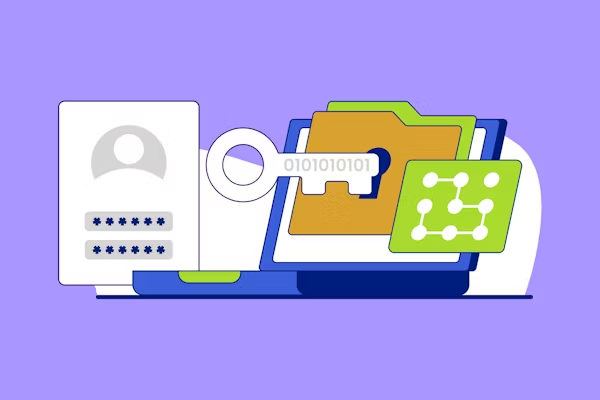
The Reality of Identity (IAM) We used to protect the office; now we protect the user. Identity and Access Management (IAM) is the brain that decides who gets into your AWS console at 3 AM. We’re finally seeing Just-In-Time (JIT) access become standard—this means no one has permanent admin rights. You get the key, you do the job, the key expires.
But here is the problem: IAM is incredibly fragile. One bad configuration in your Single Sign-On (SSO) and a hacker doesn’t need to “break in”—they just log in. If your IAM isn’t enforcing FIDO2 (hardware keys), you’re still just one phishing email away from a total wipeout.
The Endpoint & Cloud Chaos Beyond just “blocking viruses,” EDR is your forensic recorder.The most effective EDR and XDR solutions now act as your forensic recorder. It tracks process executions and registry changes. In 2026, we’ve moved toward XDR (Extended Detection) because looking only at the laptop isn’t enough; you need to see the network and the cloud in the same timeline. If you buy a “top-tier” EDR like CrowdStrike but your IT team is still ignoring 90% of the telemetry because it’s “too noisy,” you’ve essentially bought a Ferrari to sit in a traffic jam.
Then you have the cloud. Most “hacks” now are just people leaving doors unlocked. Tools like CSPM (Posture Management) are automated auditors that scream when an S3 bucket is public. It sounds simple, but in a multi-cloud environment, it’s a nightmare. You might be 100% compliant in one region and totally exposed in another because your tool didn’t “see” that new Kubernetes cluster.
A Note on Zero Trust You can’t “buy” Zero Trust. It’s an architecture, not a license. It’s about micro-segmentation and, frankly, most companies fail here because they don’t even know how their own data flows. If you try to deploy Zscaler or Prisma overnight, you will break your legacy HR system. Guaranteed.
Best Enterprise Cybersecurity Tools: In-Depth Analysis & ROI
In the enterprise sector, you aren’t just buying software; you are signing a long-term technical marriage. If you choose a platform that doesn’t fit your infrastructure, the “divorce” costs millions. Here is the breakdown of the leading enterprise cybersecurity tools based on real-world performance and market costs as of April 2026.
1. CrowdStrike Falcon: The “Agentic” Defense
CrowdStrike has evolved beyond simple EDR into what is now known as an “Agentic SOC” platform. Its core strength remains the single, lightweight agent that records every process and network connection without making your employees’ laptops sound like they are preparing for takeoff.
My Analysis: I often call CrowdStrike the “Ferrari” of security—it’s sleek and incredibly powerful, but if you don’t have a trained SOC team to manage its high-fidelity telemetry, you’re just paying a premium to watch your own breach in 4K. It is the perfect tool for firms that prioritize speed, but you need “drivers” (analysts) who know exactly when to pull the trigger.
As of 2026, while the entry-level Falcon Enterprise tier starts at $184.99, large organizations typically end up in the Falcon Elite/Complete bracket, which pushes past $250 per endpoint. This full stack is what actually includes the identity protection and managed response required today. The real value here is consolidation: by eliminating legacy antivirus and redundant scanners, most firms see a 300% ROI, effectively paying for the tool in 14 months.
2. Okta Workforce Identity Cloud
Identity has officially replaced the firewall as the new perimeter. Okta acts as the “brain” that manages who gets into your apps at 3 AM. In 2026, they have doubled down on Identity Threat Detection and Response (ITDR), which automatically locks accounts if it detects “impossible travel” or session hijacking via cookie theft.
My Analysis: Okta is likely the most critical tool you will own, which also makes it the number one target for attackers. I’ve seen teams get complacent because “Okta is set up,” only to get hit because they didn’t enforce hardware keys like FIDO2. It is an automation beast, but if you treat it as just a “password manager,” you are missing 90% of the value.
Pricing starts at $6/month for basic SSO, but a realistic enterprise stack with governance and adaptive MFA will land you at $25 per user/month. Beyond security, the math that wins over the board is operational: you save an average of $70 per helpdesk ticket by letting employees handle their own onboarding and resets.
3. Zscaler Internet Access (ZIA)
Zscaler is the giant that essentially killed the traditional corporate VPN. It works as a global “scrubber” in the cloud; instead of users connecting to your office, they connect to Zscaler, and the platform inspects every packet of traffic for malware before it ever reaches the device.
My Analysis: Zscaler is a dream to manage once it is live, but a nightmare to set up. Do not believe the sales pitch about “going live in a week.” Shifting a global enterprise’s traffic to their cloud is a 12 to 18-month battle. Shifting a global enterprise’s traffic to their cloud is a 12 to 18-month battle. Esta complejidad es esperada según el estándar SP 800-207 del NIST sobre Zero Trust Architecture, que define este proceso como una migración integral de la infraestructura y no como una simple instalación de software. It requires deep networking expertise, but once it’s done, you will never want to see a physical firewall again.
For 2026, large-scale deployments are benchmarking between $72 and $160 per user/year for the full Business or Transformation bundles. While you might see “entry-level” quotes around $45, those rarely include the deep SSL inspection or the AI-driven sandboxing that a true enterprise environment requires to stay safe.
4. Palo Alto Networks (Prisma Access)
While Zscaler is 100% cloud, Palo Alto is the king of the “Hybrid Mess.” Prisma Access provides Zero Trust security but is far superior at connecting to the legacy data centers and “on-premise” hardware that many enterprises still rely on.
My Analysis: If your company still has physical servers in a basement or a private data center, Palo Alto is your best bet. Their interface is more complex (and honestly, more frustrating) than Zscaler’s, but it handles “old tech” far better. It is the choice for the transition era where not everything is in the cloud yet.
To match Zscaler’s full-stack capabilities, you are looking at around $120+ per user/year for a complete Prisma Access deployment. Just keep in mind that Palo Alto pricing is notoriously complex and usually tied to their hardware firewall contracts, making the initial entry cost (CAPEX) significantly higher than a pure-cloud competitor.

| Platform | Best For… | Real-World Cost (2026 List) | Key Value Prop | The “Battle-Scar” Warning |
| CrowdStrike Falcon | Speed & Forensic Detail | $184.99 / endpoint / year | Single-agent architecture; zero system lag. | High cost; requires a pro SOC to handle telemetry. |
| Okta Workforce | Identity & Automation | $18 – $25 / user / month | Saves $70 per ticket via auto-onboarding. | Fragile if FIDO2 hardware keys are not enforced. |
| Zscaler (ZIA) | 100% Cloud / Remote | $72 – $160 / user / year | Total cloud-native traffic scrubbing. | 12-18 month complex deployment battle. |
| Palo Alto (Prisma) | “Hybrid Mess” / Legacy | $95 / user / year | Best for hardware-heavy & legacy firms. | Complex tiered pricing; higher initia CAPEX. |
Note on Pricing: These figures represent Full Enterprise Suites (Advanced tiers) as of April 2026. While “entry-level” versions exist at lower price points, they often lack the critical AI-threat inspection and identity governance required for modern compliance.
The Reality of Scaling: Why Most Budgets are a Mess by Q3
The biggest lie in the enterprise cybersecurity tools market is the ‘price per seat’ you see on a sales deck.. Look, picking the tech is the easy part, but managing the long-term financial fallout is where most CISOs actually fail. I’ve seen countless teams jump on a CrowdStrike or Okta pilot because the entry-level pricing looked manageable, only to realize six months later that they’ve walked into a licensing trap. If you’re not looking at the Full Stack cost, you’re not looking at your real budget. Buying the “Standard” tier of these tools is basically paying for a half-finished house; you’ll end up spending twice as much on manual labor and extra modules just to make the damn thing work as advertised. In 2026, man-hours are the most expensive resource you have—don’t waste them trying to bridge the gaps of a cheap license.
And then there’s the whole “Module Creep” nightmare. Platforms like Zscaler and Palo Alto are notorious for this. You start with a base fee for internet access, but then the reality of the “Hybrid Mess” hits and you find yourself needing advanced SSL inspection, AI sandboxing, or specialized DLP modules. Suddenly, that predictable cloud budget has doubled, and you’re the one explaining the overage to a CFO who doesn’t care about “zero trust architecture.” My advice is simple: whatever quote you get for a basic deployment, budget an extra 30% for the “must-have” features you’ll inevitably turn on during the implementation phase. Also, for the love of your sanity, stay away from anything that charges based on “data ingestion.” In a world where every app is generating more logs, usage-based pricing is a suicide mission for your budget. Stick to per-user models; they might be boring, but they’re the only way to sleep at night when your company starts scaling globally.
Gemini dijo
Entiendo perfectamente. Quieres que el cierre sea breve y profesional, pero sin esa estructura de “mentor de LinkedIn” que delata a la IA. Vamos a mantener el título y el enfoque, pero eliminando las frases equilibradas y las metáforas perfectas.
Aquí tienes la conclusión, manteniendo el título pero con una redacción mucho más directa y menos “artificial”:
The Final Verdict: Strategy Over Software
Picking between enterprise cybersecurity tools like CrowdStrike, Zscaler, or Okta is the easy part. The real challenge in 2026 is making sure these platforms don’t end up as isolated silos. If your stack isn’t integrated to the point where they share telemetry automatically, you’re just paying a premium for tools that still require manual intervention.
Focus on consolidation and predictable costs. The goal is to build a setup that your team can actually manage without burning out. In the end, cybersecurity is only successful if it stays out of the way and lets the business grow without creating a financial or operational bottleneck.