Scale Your Startup from Day 1: The Automation Guide for Solo Founders

Nowadays, seeing solo founders of their business treat their “hustle” (extreme effort) like a religion they cannot fail is becoming more common than it should be. They are proud and believe that working 14 hours a day—and that 8 to 10 of those hours are wasted by doing repetitive tasks—is something to be proud of. They actually believe that by spending more time they are working and advancing more, when really it is all the contrary since they are wasting time on repetitive tasks that they could save and be dedicating that time to something more productive for their startup Automation. That is not “building”; it is a failure of design, structure, and organization that is destroying your company. You are wasting high-value brain cells on simple but repetitive tasks that a machine could do for cents. Most founders believe they are creating something that really works with that effort and dedication, but in reality they have only built a high-stress job where really, because of the hours they end up doing a week, they end up being poorly paid. If you do the math on your salary, for your real hourly rate at the end of the month, you would probably earn more money working at a fast-food chain or in a warehouse.
This is a proven fact: according to the 2026 business automation statistics, teams using automation are now cutting out upwards of 30 minutes of manual work per task, a saving that is life-or-death for a solo founder trying to scale.
The reality is this: if your business dies or stops working the moment you stop clicking or you stop being pending of absolutely everything, you don’t have a startup. To scale today in the market without a team, the automation of tasks has to be the pillar of your business and not something you add later and don’t give enough importance to, and when you have already advanced you don’t have the time or the resources to implement these automations in a correct way.
What is Startup Automation for Solo Founders?
Startup automation is simply making your applications talk and work with each other so that you don’t have to be the middleman constantly and can dedicate your time to higher-value tasks. It is about making lead capture, billing, and onboarding among other tasks work automatically while you sleep. The real objective of automations is to replace the need for a team of 3 people with all the management it involves, the costs, and the human dramas they bring for a structure of workflows that does exactly what it is told.
The “Hustle” Trap: Why Automation is Your First Virtual Employee
Many of the cases I have seen, founders think: “I will automate when I have more income and when the business has started up.” That usually is a problem that as time goes on ends up sentencing them, because by the time the money arrives and the clients start coming in, you will be so busy with those same repetitive tasks that take away your time and that you want to automate, apart from the really important tasks, that you won’t have even ten minutes to think about the logic of the system you want to create and how you are going to do it in an intelligent and efficient way. Trying to automate when you are already saturated with work is the first thing that will make you fail in your attempts to automate your startup.
Automation is the best contract you will sign inside your company. Unlike a human, a workflow doesn’t get distracted, doesn’t need 24-hour-a-day supervision, and doesn’t get offended when you change the process. It delivers the same result every time and in the specific way you have asked for.
The Essential No-Code Stack for the One-Person Startup
You don’t need a corporate suite of 2,000 dollars a month. You only need a place to store data and a “glue” that prevents everything from exploding.
Workflow Orchestrators: Why we choose Make over Zapier
Zapier is the famous option, the one you surely see in all the “Top 10” lists because it is easy to use. But most end up changing to Make for its features. It is not only for saving money, it is for the logical freedom that Make offers inside its services.
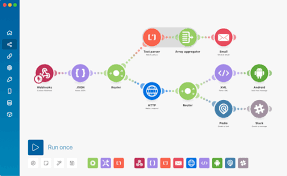
Zapier forces you to follow linear and boring paths that sometimes don’t serve for everything, instead Make is a blank paper where you have more freedom and it allows you to build complex routes with many branches and different paths that really adapt to the chaotic reality that a growing business can have. I have seen people pay hundreds of dollars for “tasks” in Zapier that would cost 15 dollars in Make. If you want a system that survives the growth of your company without creating a mountain that gets bigger every time because of the growth of your company and that in the end you have to pay more later, Make is the option that will surely serve you more for its features and services.
The Data Backbone: Building Your SSoT with Airtable
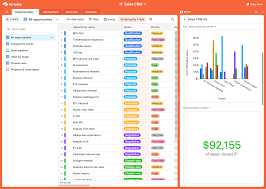
Close the Excel sheet you are using right now. Airtable is your new option that acts as your command center. It looks like a spreadsheet like Excel, but it is a database that keeps your entire system connected to each other and with a good functioning. If a lead enters, or a payment is confirmed, or a support ticket is opened, it has to be inside Airtable. If a piece of data is not in Airtable, with all certainty it no longer exists.
3 Critical Workflows to Activate on Day 1
1. Frictionless Lead Capture & Onboarding
When a lead fills your form, the clock starts running. If you take 4 hours to respond because you were having lunch, very probably they have already gone to the competition. In less than 30 seconds, that lead must be in Airtable, receive a personalized email (via ConvertKit or Beehiiv) and have their folders in the cloud ready. Velocity is the best option you have when you are small.

2. Hands-off Billing and Subscription Management
Chasing invoices is a waste of time that often takes place in many companies, and it is one of the biggest and silliest wastes of time you can have. Use Stripe and connect it to everything. If a card is rejected, let the system send three automatic reminders, each one a bit more direct. When the money arrives, the invoice must generate and archive itself alone for the tax season. You should only look at Stripe to see how the revenue line goes up and to make sure it is really working and to realize the time saved and the efficiency of the automation.
3. Support Triage through AI and WhatsApp
You should not be responding to messages at midnight nor be connected 24 hours a day being pending of the messages that might arrive to you and of answering them fast to give a good image and a good service of your company. Connect the WhatsApp Business API with OpenAI. In the US, although email is the king for documents, WhatsApp is becoming the tool to “close” high-value sales. Build a bot that handles the “dumb” questions instantly in the chat. If someone is really angry or has a real crisis, let the AI mark it as “Urgent” and notify your phone. In this way, you really only spend your time and intervene when it is really necessary to save a deal or to offer a more complex or unusual response to a client and to give them the best treatment possible.
The Hidden Risks of Automating Too Early
Here is where I really made a mistake: automation scales the mess and makes everything orderly and structured. If your manual process is garbage, automation will simply make that garbage happen faster, but the result will end up being almost the same, and that does not interest us. That is why it is very important that at the time of applying these automations it is done in a very correct and structured way so that really the process is worth it and a good result and performance is seen thanks to automation. And it is worth it at the beginning to lose a bit more time to later recover that time and much more to do more important things.
This is an example: Once I configured a structure in Make that had to sync new clients from Stripe with a mailing list. I made a mistake in a filter and the system entered into an infinite loop, and sent 400 “Welcome” emails to the same client in ten minutes. I woke up with a voice message from the client and a lost client account.
The Golden Rule: Do not automate absolutely anything that with the manual process and in a manual way you have not done with success and with a good result several times. You need to know exactly where the process breaks before letting a machine do it for you.
The Mechanic’s Rule: Systems Break (And That’s Okay)
Do not believe the lie of “set it and forget it”. APIs change, tools update, and workflows break. But this can be solved by dedicating 30 minutes every first Monday of the month to review your automations and workflows. Check the execution logs of Make. Look for “incomplete executions” in Airtable. A system that is not maintained ends up becoming a burden. Build a “Failure Alert” workflow: if a scenario fails, have it send you an SMS immediately.
ROI Analysis: The Opportunity Cost of Your Time
Look at the numbers without ego. A part-time virtual assistant (VA) in the US costs between 800 and 1,500 dollars a month for basic tasks. A powerful stack of Make + Airtable + OpenAI costs about 150 dollars a month approximately, although it might vary. But the real math is the Opportunity Cost. If this system saves you 20 hours a month, and you use that time to be able to advance in other more important tasks or you can focus on scaling your business, those 150 dollars didn’t cost you money: they generated much more benefit than the cost you had. Every hour you spend copying and pasting is an hour you don’t dedicate to high-impact growth. It is a 15-hour setup tax in exchange for permanent financial freedom. This philosophy is exactly what is preached in Stripe’s strategy guide for startups, which emphasizes that creating a lean, automated business model is the only way to remain profitable while moving at high speed.
Frequently Asked Questions (FAQ)
Do I need to be a developer? No. This is “No-Code”. But you need logic. If you can’t draw a flow chart of your business on a napkin, no tool is going to save you.
Should I use an “all-in-one” platform? No. All-in-one tools are a trap. They are mediocre at everything. It is much better to have the best specialists (Stripe for payments, Airtable for data) and use Make as glue. If one tool fails, you simply substitute that piece.
Where do I start if I’m overwhelmed? The 3R Rule: Is it Repetitive? Is it based on Rules? Is it about moving Records? If it hits all three, stop doing it yourself. You are literally losing money every time you click that button.
Conclusion: Your Startup as a System, Not a Job
Stop trying to be the one who works the most, although that is fine prioritize working intelligently. Be the one who has the best system. Automation is the only way that allows a solo founder to compete with funded teams. While your competitors are trapped in meetings deciding how to file PDFs and wasting time in a ton of tasks they can automate, you will be scaling revenue and improving your company with the machine you built on Day 1.